US Federal Government Directory › Judiciary › Clarence Thomas
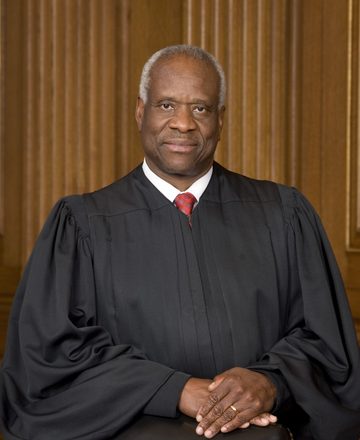
Clarence Thomas
Associate Justice of the Supreme Court of the United States

Background
Clarence Thomas has served as an Associate Justice since October 1991 and is the longest-serving member of the current Court. He previously served as a judge on the U.S. Court of Appeals for the D.C. Circuit, as chairman of the Equal Employment Opportunity Commission, and as Assistant Secretary of Education for Civil Rights. He is a graduate of the College of the Holy Cross and Yale Law School, and is known for his originalist and textualist approach to constitutional interpretation.
Notable opinions (OT2023-OT2025)
| Garland v. Cargill Bump stocks are not machine guns under the National Firearms Act; ATF exceeded its statutory authority. source |
| Free Speech Coalition v. Paxton Texas age-verification law for porn sites imposes only an incidental burden on adults' speech and survives intermediate scrutiny. source |
| Trump v. Barbara Would have upheld the birthright-citizenship order; dissented from the Citizenship Clause majority. source |
| Trump v. Cook Called blocking Trump's firing of Fed Governor Lisa Cook an unprecedented incursion on presidential authority. source |
Selected notable opinions from the three most recent completed Supreme Court terms. Roles, dates, and vote splits are taken from the linked sources; summaries describe what each opinion held, not the underlying facts.
Latest statements
Family
- Virginia "Ginni" Thomas (spouse)